Marriage
Congratulations
You are preparing to celebrate one of the most important events in your life—your Marriage. You have chosen to do so in the context of the faith community at St. Regis Parish. We want to welcome you and support you on this journey of life and faith.
Sacred Scripture begins with the creation of man and woman and ends with the “wedding feast of the Lamb” (Rev 19:7, 9). Throughout Scripture, marriage is revealed as a gift from God: a sacred vocation through which a husband and wife grow in love and discover more deeply God’s love for them.
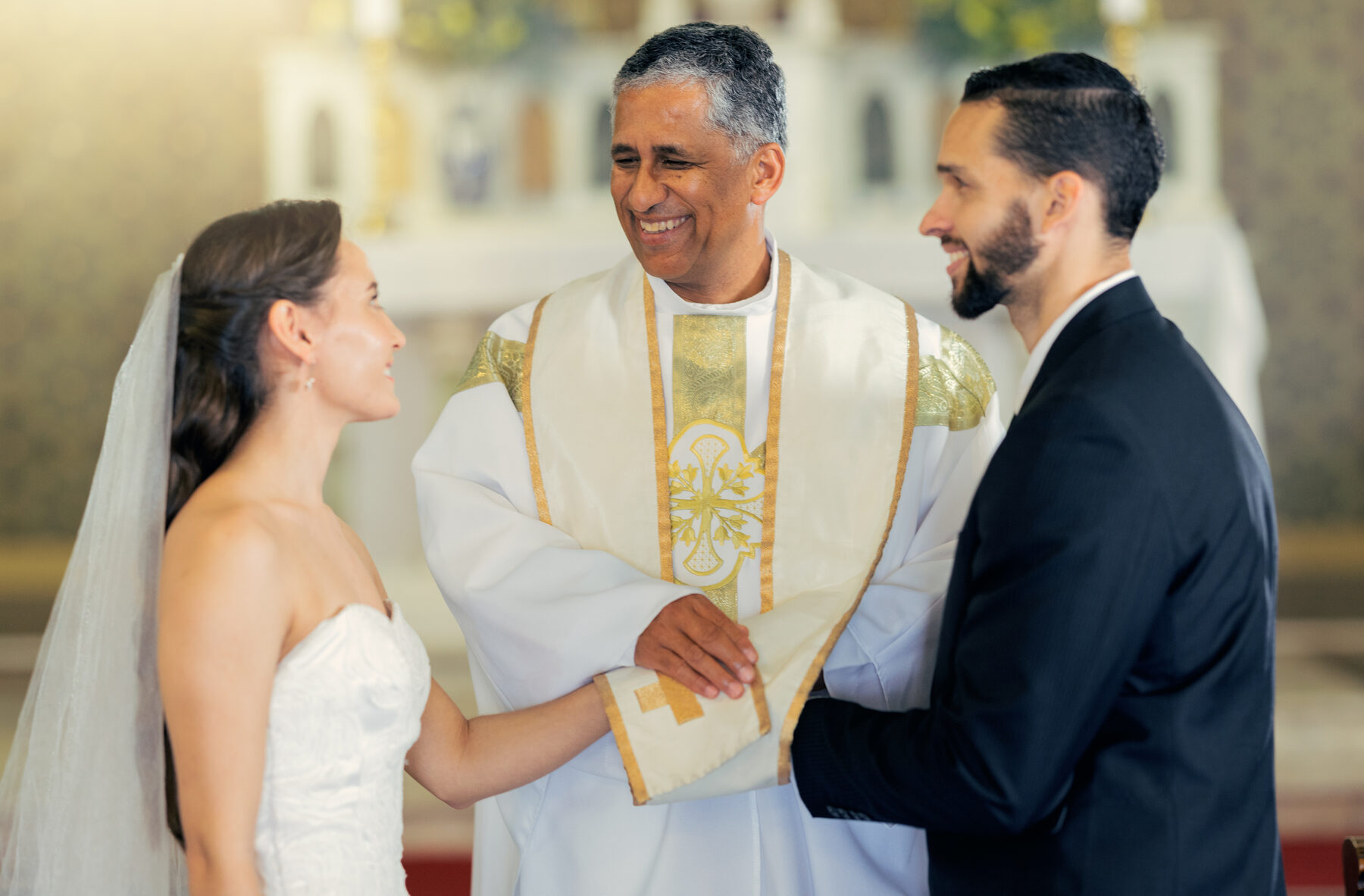
In the Sacrament of Marriage, the couple’s covenant becomes a visible sign of Christ’s faithful, self-giving love for his Church. Marriage is more than a legal agreement; it is a lifelong relationship in which husband and wife freely give themselves to one another, promising to love and cherish each other faithfully. Through daily care, forgiveness, joy, and sacrifice, they walk together with God, grow in faith, and encounter his presence in ordinary life.
Because marriage is a sacrament, its celebration is also an act of worship and prayer. The Church gathers joyfully with the couple, their families, and friends to pray for God’s blessing upon their life together. Catholics are encouraged to celebrate marriage within the Eucharistic Liturgy, joining their covenant to Christ’s self-giving love. Through this vocation, couples become living witnesses of Christ’s love to one another, their families, and the world.
Preparation for the Sacrament of Marriage
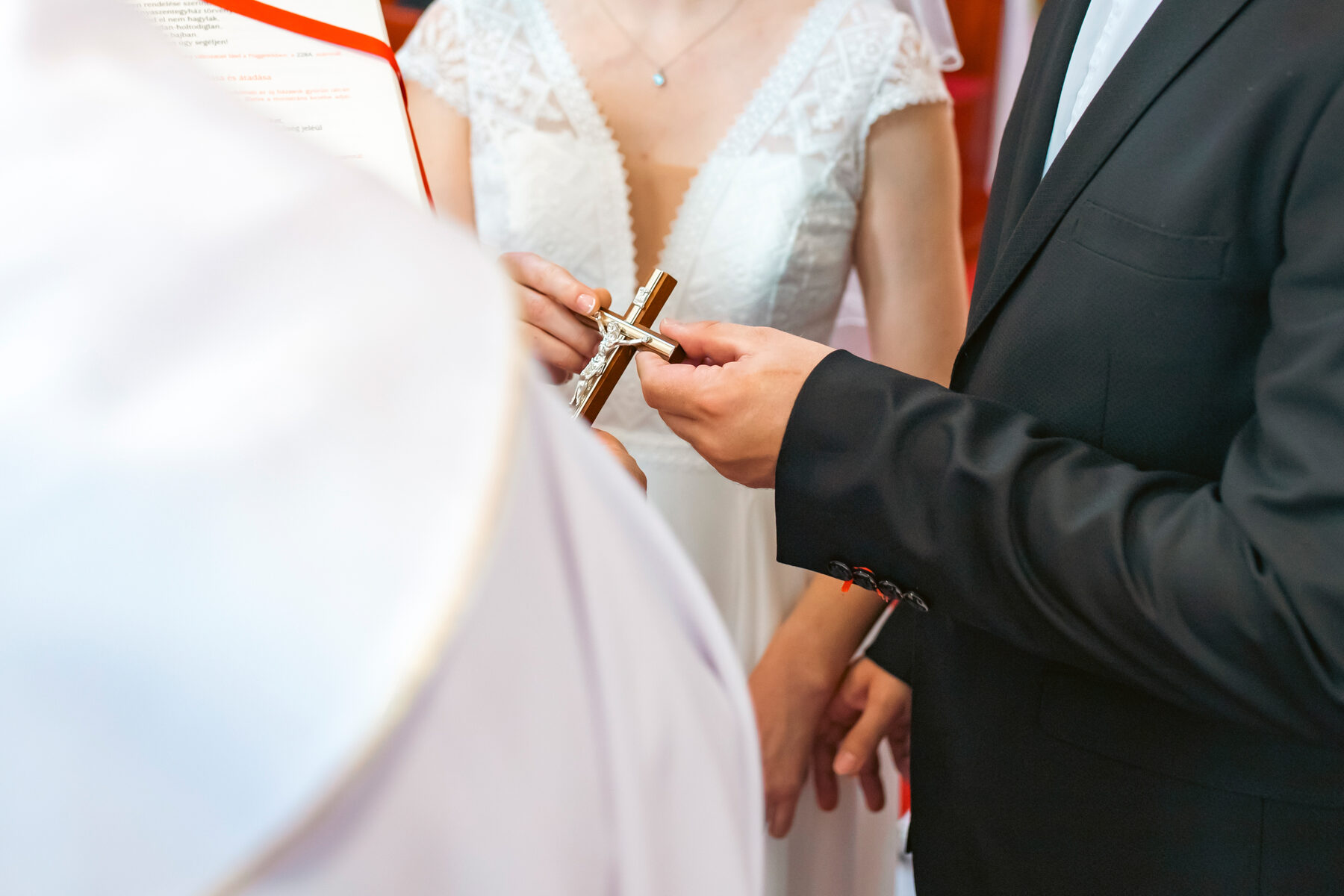
We are delighted to accompany you as you prepare to celebrate the Sacrament of Marriage at St. Regis Catholic Church. Your engagement is a special time of prayer, preparation, and joyful anticipation as you begin this new chapter together.
Following the Pastoral Guidelines for Marriage Preparation of the Archdiocese of Detroit, our preparation process helps engaged couples deepen their understanding of marriage as a sacred vocation and lifelong covenant. Couples are invited to strengthen their relationship, reflect on the joys and responsibilities of married life, and grow closer to God.
Please contact the parish at least six months before your anticipated wedding date. This allows time to meet with the Pastor, complete the necessary preparation, and prayerfully prepare to receive the sacrament.
To begin planning your wedding or learn more about marriage preparation, please contact Agnes Villarreal at [email protected]
Five Things to Know When Preparing for a Catholic Wedding
The Catholic Church celebrates marriage as one of the seven sacraments: a sacred, lifelong covenant of love and fidelity.
- Contact the Parish Office
Contact St. Regis at least six months before your anticipated wedding date, preferably before confirming a date or making arrangements with vendors.
- Confirm Your Freedom to Marry
At least one person must be a baptized Catholic, and both must enter marriage freely and be eligible to marry in the Church. A mixed marriage may require permission; marriage to an unbaptized person requires a dispensation. The Catholic spouse promises to remain faithful to the Catholic faith and make every reasonable effort to have the couple’s children baptized and raised Catholic. Previous marriages may require an annulment or declaration of nullity.
- Complete Marriage Preparation
Following Archdiocese of Detroit guidelines, couples participate in preparation that may include meetings with the priest, a marriage preparation program, a premarital inventory, prayer, and reflection.
- Gather the Necessary Documents
Required documents may include birth and recently issued baptismal certificates, sacramental records, proof of freedom to marry, applicable permissions or dispensations, previous-marriage documentation, and a Michigan marriage license. The parish will explain what applies to you.
- Celebrate Marriage as a Sacrament
Your wedding is both a joyful celebration and a sacred act before God and the Church. Catholic couples are encouraged to celebrate marriage within the Eucharistic Liturgy.
St. Regis is here to answer your questions and accompany you as you prepare for a lifetime of love and faith together.
St. Regis Catholic Church is grateful to celebrate the Sacrament of Marriage with couples connected to our parish community. Registered parishioners who are free to marry in the Catholic Church may generally celebrate their wedding here.
Catholics living within the parish boundaries who are not yet formally connected with St. Regis are warmly invited to contact our parish staff. We would be happy to discuss becoming part of our community as you prepare for marriage.
We also welcome children of active parishioners who are away at school or living outside the parish boundaries. If you have another family connection to St. Regis, please contact us to discuss your plans.
Whatever your connection, we encourage you to reach out early. We look forward to learning about you and accompanying you as you prepare for this beautiful vocation.
What if I or my fiancée has been married previously?
Please tell the priest or pastoral staff member at your first meeting if either person has been married before, whether the marriage involved Catholics or non-Catholics and took place in a church or civil setting.
Before a wedding date can be set, the Church must determine that both individuals are free to marry under Catholic law. A previous marriage may require a declaration of nullity, commonly called an annulment; civil divorce alone does not establish freedom to marry in the Church.
Every situation is unique. Our pastoral staff will listen without judgment, explain any necessary steps, and help you move forward with clarity and peace.
Contact St. Regis at least six months before your hoped-for wedding date. This minimum period allows time for thoughtful preparation for the lifelong vocation of marriage; couples are always welcome to contact us earlier.
Your first step is to meet with the Pastor or another pastoral staff member. During this meeting, you will discuss your hopes for marriage, review the preparation process, and ask questions.
Setting Your Wedding Date
Wedding dates cannot be scheduled by phone and should not be considered confirmed before your initial meeting. Please contact the parish before reserving a reception venue or making other arrangements. Once the necessary requirements have been reviewed, you may set your date with the parish.
Generally, only one wedding is scheduled each day so that St. Regis can accommodate Masses, funerals, wakes, meetings, and other parish needs. We recommend bringing two or three possible dates.
What times are available for the wedding celebration?
- Friday: Generally 5:00 or 6:00 p.m.
- Saturday: Between 12:00 noon and 1:30 p.m. The 1:30 p.m. time allows for the wedding, photographs, and church preparation before Reconciliation at 3:00 p.m.
- Saturday evenings and Sunday afternoons or evenings: Separate weddings are not scheduled.
Weddings During Lent
Because Lent is a season of prayer and preparation, weddings are generally not scheduled during Lent. If considering a March or April date, please check that year’s Easter date and speak with the parish before making plans.
What if we want to be married sooner than the six months or find we need to change our wedding date and be married sooner?
Although six months is normally required, every couple’s circumstances are unique. If you hope to marry sooner or must move your wedding to an earlier date, speak with the priest or pastoral minister guiding your preparation.
Marriage preparation is designed to be a meaningful and enjoyable part of beginning your life together. Using Archdiocese of Detroit resources, you will meet with a priest, deacon, or married couple. The number of meetings depends on your needs, and some preparation may occur online.
Conversations may explore family backgrounds, communication, strengths and challenges, careers, finances, natural family planning, raising children, and growing together in faith.
Documents and Marriage Records
The parish will guide you through paperwork establishing your freedom to marry and creating the Church’s marriage record. Each Catholic must provide a baptismal certificate issued within the past six months. Baptized non-Catholics should provide a baptismal record when available. You do not need everything for your first meeting.
Preparing Your Wedding Liturgy
A liturgy workbook will help you select Scripture readings, prayers, and other elements. You will also meet at no cost with the Director of Liturgical Music. Parish or outside musicians may be used, but all music requires the director’s approval.
About one month before the wedding, you will finalize the liturgy with the presiding priest or deacon. Please wait until afterward to print programs.
What if we are of different faiths?
An interfaith marriage is not considered a lesser marriage. Faith differences will be discussed honestly during preparation. The Catholic promises to remain Catholic and do all that is reasonably possible to baptize and raise the children Catholic. The non-Catholic is not pressured to convert, although a separate journey toward becoming Catholic may begin during preparation.
What if a couple is living together, will the Church allow a marriage?
Couples living together will not be judged or turned away for that reason alone. You are encouraged to speak openly about your circumstances and consider how sacramental marriage will deepen your relationship through a lifelong covenant of love, fidelity, and mutual care.
Who Participates in the Wedding Liturgy?
Who needs to be there?
The wedding liturgy is first and foremost the prayer of the Church. In the Catholic tradition, the bride and groom are the ministers of the sacrament, giving themselves to one another through their vows. A priest or deacon and at least two witnesses must also be present.
Inviting a Priest or Deacon You Know
Ordinarily, the Pastor or another St. Regis priest or deacon presides. Couples wishing to invite another priest or deacon should discuss this early in their preparation. Visiting clergy must meet Church and parish requirements, including providing a letter of good standing when required.
Who else has an official role at the wedding?
Family and friends may serve as witnesses, lectors, ushers, greeters, and, during Mass, qualified Extraordinary Ministers of Holy Communion. Those with liturgical roles should attend the rehearsal. Ring bearers and flower girls are optional; young children should process with an adult.
What options are allowed for the opening procession?
Two forms of the entrance procession are available. The Church prefers that the couple enter together as ministers of the sacrament. An alternative procession with the bride and her parents entering last may also be used. Variations on either option require the presider’s approval.
Should our marriage take place in the context of the Eucharist?
Two practicing Catholics ordinarily marry within Mass. When one person is not Catholic or the couple is not active in the Catholic faith, a Liturgy of the Word is generally more appropriate and is not a lesser celebration.
May our marriage ceremony take place outdoors or in a non-Church setting?
Weddings ordinarily take place inside a church.
What about including certain cultural/devotional customs in the wedding liturgy?
Cultural or devotional customs must be discussed with the presider.
How do we schedule a wedding rehearsal?
If there is to be a wedding rehearsal you can schedule a time for the rehearsal, when you meet with the presider to go over the liturgy. The rehearsal time can be affected by other church events. Ordinarily it is the day before or two days before the wedding.
How do I arrange for music at my wedding?
All music requires parish approval and must be suitable for Catholic worship; secular songs belong at the reception.
Should we have a receiving line at church?
Remember that the photographer has one half hour from the end of the liturgy to be done with the pictures. This is true, whether there is a receiving line or not. A receiving line will cut greatly into the time for pictures. In addition, almost always the couple needs to receive people at the reception and so it duplicates something that will take place later. We invite the wedding party to process out and stay together while the rest of the assembly exits. Then pictures can begin back in the church.
What kind of flower arrangements are we allowed? What about runners, etc.?
Lots of attention to details are called for at weddings. But, the simpler you keep the wedding day and environment, the more relaxed you can be yourselves on that day. The simpler you keep your wedding, the more you can keep things focused on the essentials: your wedding vows together and the sharing of the day with family and friends. The simpler you keep the day, the more you make it a witness to the presence of the Lord in your lives at that time.
The environment of the church is important for any liturgy. You may add to the environment by contracting the services of a florist, but it is not required. Any flowers should be tasteful and not excessive, especially if they are being left as a gift for the rest of the community to enjoy during their prayer. One larger arrangement or two smaller arrangements seem to work best in our church. No one may re-arrange the liturgical decorations to fit the color of the wedding flowers/dresses/etc. Flowers are never placed on the altar. Since the church is not open until about one hour before a wedding, you should let the florist know that.
Bows on the end of rows are allowed, as long as they do not damage the wood and are removed at the end of the liturgy. No use of runners is allowed. It is never allowed to scatter rose petals or any other decorations on the floor of the church.
Please do not plan on throwing rice, bird seed, or releasing balloons/doves after the wedding liturgy, and please let family members and guests know that this is not allowed. These customs interfere with the maintenance of our building and grounds. In the case of rice or bird seed, it creates a mess. In the case of balloons, it is environmentally unsound. In the case of doves, it has no place as part of the ceremony at church. Again, think of the wedding day as a whole day. Some things that do not fit the church celebration can be done as part of the reception or dinner time.
When considering such extraneous details, please remember that the most important symbol any time the Church gathers to pray is the people who gather, for we ourselves are the Church. By choosing Scripture readings and music that speak of your faith as a couple, by welcoming people warmly as they arrive, by keeping the day and all of its extraneous costs as simple as possible, and by considering carefully how to make your wedding liturgy prayerful, sacred, and joyful, you will ensure a meaningful day that you will remember, along with your family and friends.
It is very important that any outside person understand that the wedding ceremony is a liturgy and that the prayer and the prayerful atmosphere takes precedence over any specific photo or style. Some couples hire a wedding planner to coordinate the wedding. If you do so, be sure to let that person know that they have no say in how the Church’s liturgy takes place and must accept any guidelines as to music, flowers, and so forth.
Most couples hire a photographer and/or videographer for the wedding day. They can help provide a beautiful remembrance of the day, but they too must follow the church’s guidelines. They are to introduce themselves to the presider before the liturgy so that he can give them any last minute instructions.
Videographers must remain out of the way and stationary. They cannot move their camera by hand or on a stand, once the liturgy begins. The acceptable places for their cameras will be shown to them by the wedding rehearsal coordinator or presider. This means behind the guests who are at the wedding. Also, videographers, once the procession is up front, must use natural lighting only.
The photographer is allowed to take flash photographs of the procession in and out. However, under no circumstances is he/she to stop the procession in order to get a better picture. Once the procession is up front the photographer must remain along the back of the church and use only natural lighting. After the wedding is over, the photographer has one half hour to take photos of the family and wedding party.
We ask that you fill out the form below, have the photographer and videographer sign it, and turn it in at the rehearsal. In this way we have a record if a problem arises.
Is there a fee to paid to the church for my wedding?
Because of your connection to the Christian community, the Sacrament of Marriage is gladly celebrated with you. There is no required parish fee.
Many couples choose to make a donation supporting the ongoing work of St. Regis. Donations are appreciated but never required. A typical donation is $300–$500, although there is no expected amount. Checks should be made payable to St. Regis Parish; the donation goes to the parish, not the presider.
No additional payment is expected when the Pastor or a parish deacon presides. If another priest presides, it is customary to offer him a stipend for his ministry. Fees for musicians are arranged directly with the music ministers.
What are the Marriage Banns I see printed in some church bulletins?
Marriage banns are notices traditionally published in the parish bulletin on three successive Sundays to announce a couple’s intention to marry. Once used to help establish the couple’s freedom to marry, they now serve primarily as an announcement.
Banns are not required and are usually omitted at St. Regis. Instead, the upcoming marriage is generally announced in the Sunday bulletin one week beforehand.
In Conclusion
These guidelines will help you coordinate the many details of your wedding liturgy. Remember, however, that your deepest preparation is not simply for one ceremony, but for a lifetime of commitment, respect, faith, and shared love.
No meeting or book can replace open and honest communication between you. We encourage you to devote even more care to preparing for your marriage than to planning your wedding day. Our prayers will be with you throughout this joyful journey.